
Labs
CAREER OPPORTUNITIES
We are looking for exceptionally talented and ambitious postdocs, students, and research associates to join our team. We welcome inquiries from candidates with a genuine drive to do bold, high-impact science. Please contact us at mcolonna@mgh.harvard.edu with your CV and a brief statement of research interests.
FEATURED RESEARCH
|
Science · 2026
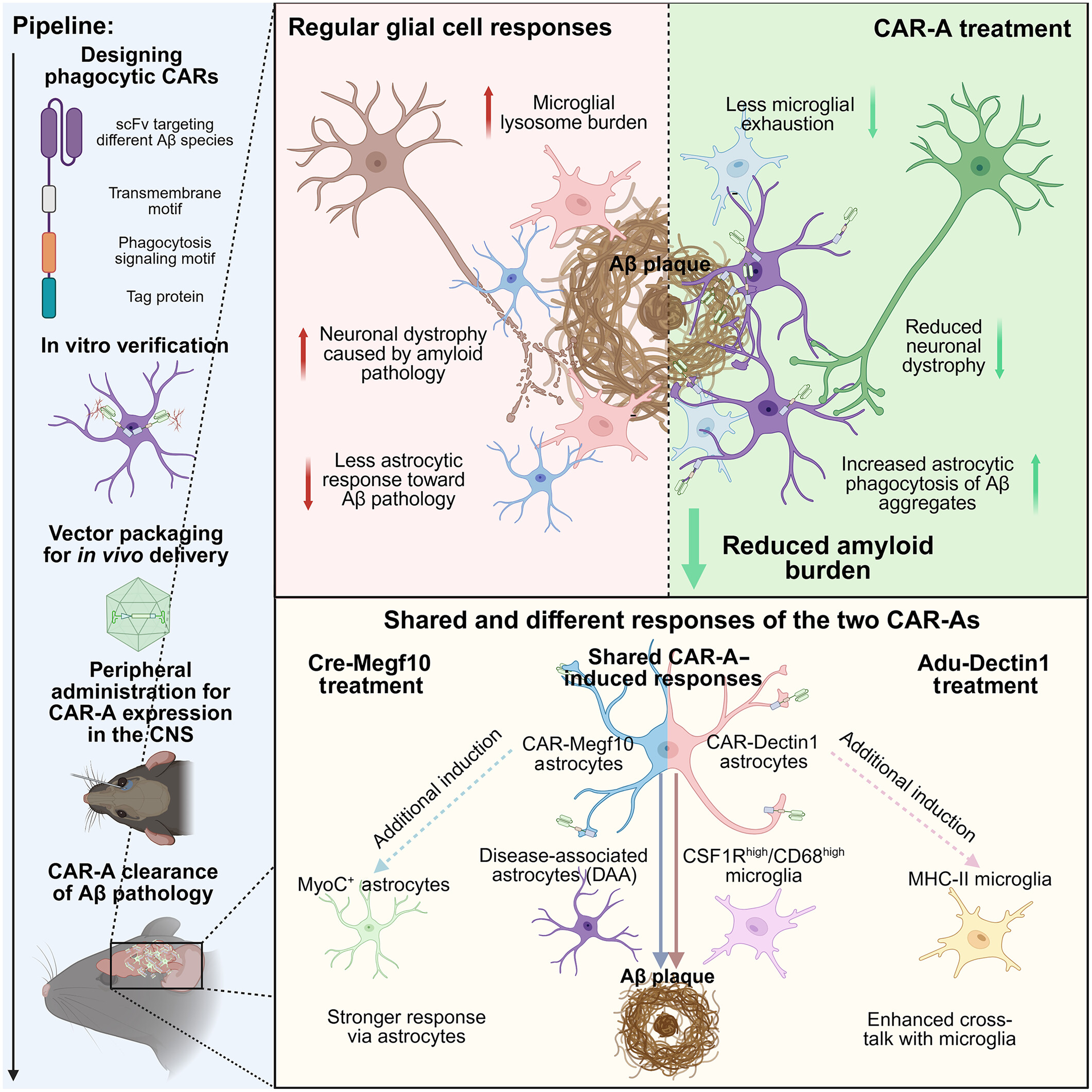
New in Science: A CAR-based astrocyte therapy for Alzheimer's diseaseOur lab reports a new chimeric antigen receptor astrocyte (CAR-A) strategy for clearing amyloid-β pathology, published in Science (March 2026). By engineering astrocytes to express anti-Aβ chimeric antigen receptors, delivered noninvasively via a single systemic AAV injection, we show that a one-time treatment can both reduce established amyloid plaques and prevent their formation in a mouse model of Alzheimer's disease — reshaping microglial and astrocytic responses to amyloid in the process. |
RECENT PUBLICATIONS
Brioschi S, Belk JA, Storck SE, Wu Y., et al. Brain perivascular macrophages regulate endothelial cell function via a cMAF-dependent transcriptional program in mouse and human. Cell. 2026.
This study shows that brain perivascular macrophages use the gene cMAF to keep blood vessels healthy via IGF1 signaling, and this protective program is disrupted in Alzheimer's patients carrying the APOE4 risk gene.
PDFAntonova AU, et al. Age- and tissue-dependent diversity of human plasmacytoid dendritic cells uncovers a cycling subset dominant in early life and cancer. Immunity. 2026.
The study reveals tissue- and age-dependent programs that shape human plasmacytoid dendritic cell biology and identifies a proliferative pDC population that may give rise to a rare blood cancer, linking normal immune development to malignancy.
PDFFachi JL, Trsan T, et al. LINGO4 coordinates ILC3-intrinsic IL-22 production and microbiota-mediated ILC3 homeostasis. J Exp Med. 2026.
The study identifies LINGO4 as a key regulator of ILC3 metabolism and IL-22 production, linking these immune cells to the composition of the gut microbiota. This interaction shapes intestinal barrier immunity and susceptibility to enteric infection.
PDFChen X, Holtzman DM, Colonna M. Immunity in Alzheimer's disease: From mechanisms to therapies. Immunity. 2026.
The review synthesizes emerging evidence that stage-specific immune responses shape Alzheimer's disease progression, providing a framework for precision immunotherapies that target disease at different stages.
DOIFachi JL, et al. Divergent ILC3 responses to PDGF-D control mucosal immunity. Sci Immunol. 2026.
The study reveals that PDGF-D activates distinct ILC3 immune programs through evolutionarily divergent signaling pathways, shaping intestinal barrier immunity and host defense against enteric infection.
DOIRodrigues PF, Wu S, et al. RORγt+ dendritic cells are a distinct lymphoid-derived lineage. Sci Immunol. 2026.
The study identifies RORγt+ dendritic cells as a distinct immune cell lineage that promotes tolerance to food and commensal microbes and defines the developmental pathways that generate them.
PDF